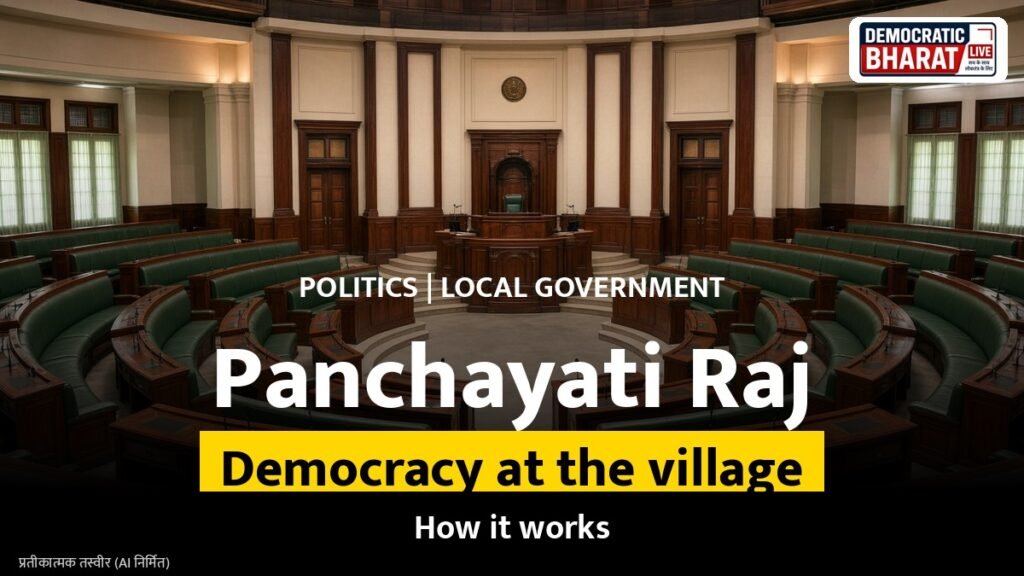
Panchayati Raj is the system of rural local self government in India. It brings democracy to the village level, letting people elect their own representatives to plan and run local development. Here is a guide.
Background
Panchayats have a long history in India. After Independence, the Balwant Rai Mehta Committee in 1957 recommended a three tier system of rural local government. Rajasthan was the first state to adopt it in 1959, at Nagaur. But panchayats remained weak in many states, with irregular elections and few powers.
The 73rd Amendment
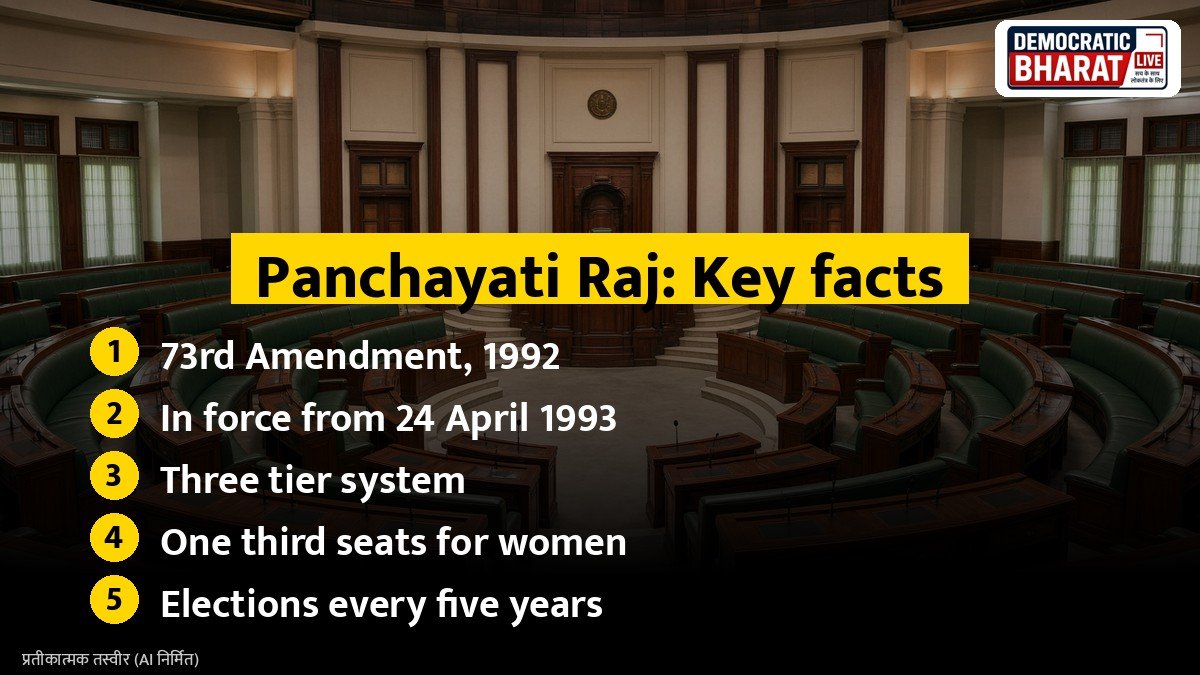
The Constitution (73rd Amendment) Act, 1992 gave constitutional status to panchayats. It came into force on 24 April 1993, which is now observed as National Panchayati Raj Day. It added Part IX, with Articles 243 to 243O, and the Eleventh Schedule to the Constitution.
Three tier system
- Gram Panchayat at the village level.
- Panchayat Samiti or Block Panchayat at the intermediate level.
- Zila Parishad at the district level.
States with a population of less than 20 lakh may skip the intermediate level.
Also Read: No-Confidence Motion Explained: How It Works in the Lok Sabha and What Happens if a Government Loses | Delimitation Explained: How Lok Sabha and Assembly Seats Are Redrawn and Why the Next Exercise Matters
Gram Sabha
The Gram Sabha consists of all registered voters in a village. It is the foundation of the system. It approves plans, selects beneficiaries for schemes and holds the panchayat accountable through social audits.
Key features
- Regular elections every five years, conducted by the State Election Commission.
- If a panchayat is dissolved early, elections must be held within six months.
- Reservation of seats for Scheduled Castes and Scheduled Tribes in proportion to their population.
- At least one third of seats and chairperson posts reserved for women. Many states have raised this to 50 percent.
- A State Finance Commission every five years to recommend sharing of funds with panchayats.
Powers and functions
The Eleventh Schedule lists 29 subjects that states can transfer to panchayats, including agriculture, drinking water, rural roads, primary education, health, sanitation and poverty alleviation. How much power panchayats actually have depends on each state’s laws.
Funding
Panchayats get funds from:
- Grants recommended by the central Finance Commission and State Finance Commissions.
- Central and state schemes.
- Their own revenue, such as local taxes and fees.
PESA
The Panchayats (Extension to Scheduled Areas) Act, 1996 extends panchayat provisions to Fifth Schedule tribal areas with special powers for Gram Sabhas over land, forests and local resources.
Digital tools
The Ministry of Panchayati Raj runs portals like eGramSwaraj for planning and accounting, and the SVAMITVA scheme to give property cards to rural households.
Bottom line
The 73rd Amendment made panchayats a permanent part of India’s democracy. Strong Gram Sabhas and adequate funds are key to making village self government work.
Source / स्रोत: Ministry of Panchayati Raj, Constitution of India, Legislative Department, Press Information Bureau