Lata Mangeshkar was the most celebrated playback singer in Indian history. For more than seven decades her voice gave life to film songs, devotional music and patriotic anthems. Here is a look at her life and legacy.
Early life
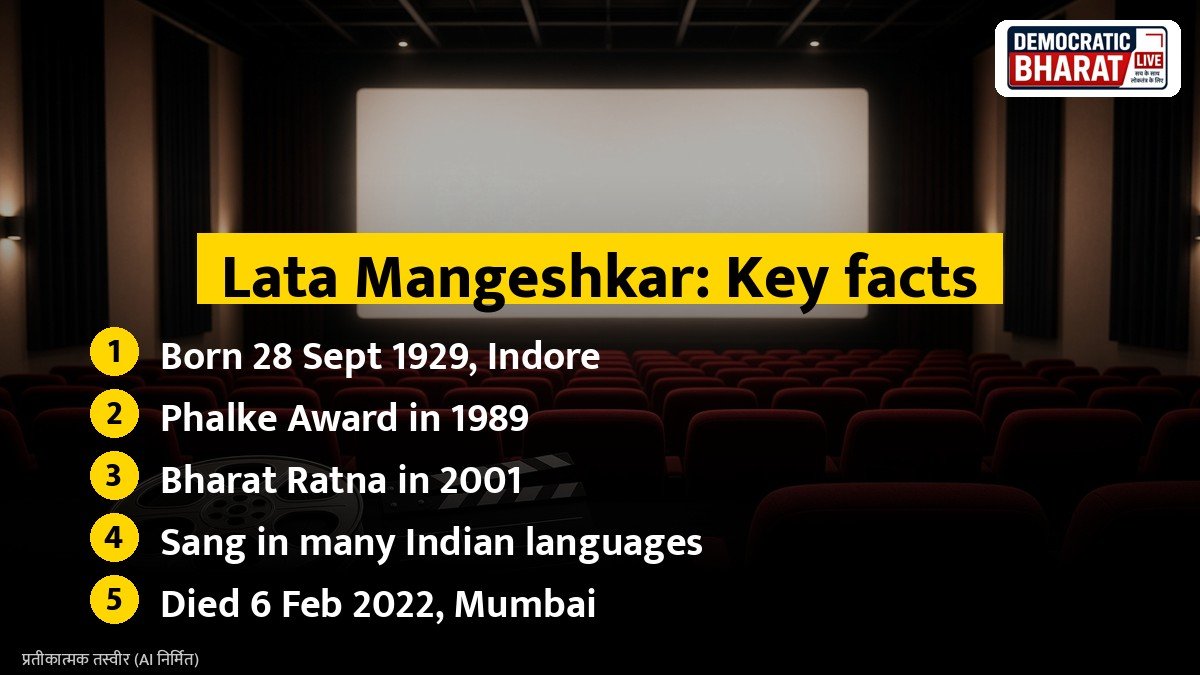
Lata Mangeshkar was born on 28 September 1929 in Indore. Her father, Pandit Deenanath Mangeshkar, was a classical singer and theatre artist. After his death in 1942, young Lata began acting and singing to support her family. Her siblings Meena, Asha, Usha and Hridaynath also became noted musicians.
Rise in films
She moved to Mumbai in the 1940s. Composer Ghulam Haider is often credited with giving her an early break. The song Aayega Aanewala from the 1949 film Mahal became a huge hit and made her a household name. Through the 1950s and 1960s she worked with leading composers such as Naushad, S D Burman, Shankar Jaikishan, Madan Mohan and C Ramchandra, and later with Laxmikant Pyarelal, R D Burman and A R Rahman.
Iconic songs
- Aye Mere Watan Ke Logon, a patriotic song first sung live in 1963.
- Pyar Kiya To Darna Kya from Mughal-e-Azam.
- Lag Ja Gale from Woh Kaun Thi.
- Ajeeb Dastan Hai Yeh from Dil Apna Aur Preet Parai.
- Tujhe Dekha To from Dilwale Dulhania Le Jayenge.
Also Read: Sangeet Natak Akademi Awards: How India Honours Musicians, Dancers and Theatre Artists | Satyajit Ray: Life, Apu Trilogy, Honorary Oscar and Legacy of a Master Filmmaker
Range and languages
She sang in Hindi, Marathi, Bengali and many other Indian languages. She also composed music for some Marathi films under the name Anandghan. She was known as the Nightingale of India and was widely called Lata Didi.
Major honours
- Padma Bhushan in 1969 and Padma Vibhushan in 1999.
- Dadasaheb Phalke Award in 1989.
- Bharat Ratna, India’s highest civilian honour, in 2001.
- Several National Film Awards and Filmfare honours. She later withdrew from Filmfare competition to encourage new talent.
- She was also nominated to the Rajya Sabha, where she served from 1999 to 2005.
Death and legacy
Lata Mangeshkar died on 6 February 2022 in Mumbai at the age of 92. The government declared two days of national mourning, and she was given a state funeral. Ayodhya has a square named Lata Mangeshkar Chowk in her honour.
Bottom line
From Mahal to modern hits, Lata Mangeshkar’s voice became part of India’s daily life. Her songs remain loved across generations.
Source / स्रोत: Ministry of Home Affairs, Bharat Ratna list, Directorate of Film Festivals, Dadasaheb Phalke Award, Press Information Bureau