To buy and hold shares, ETFs, bonds and some other securities in India, you need a demat account. It holds your investments in electronic form, much like a bank account holds money. Here is a guide to opening one.
What is a demat account
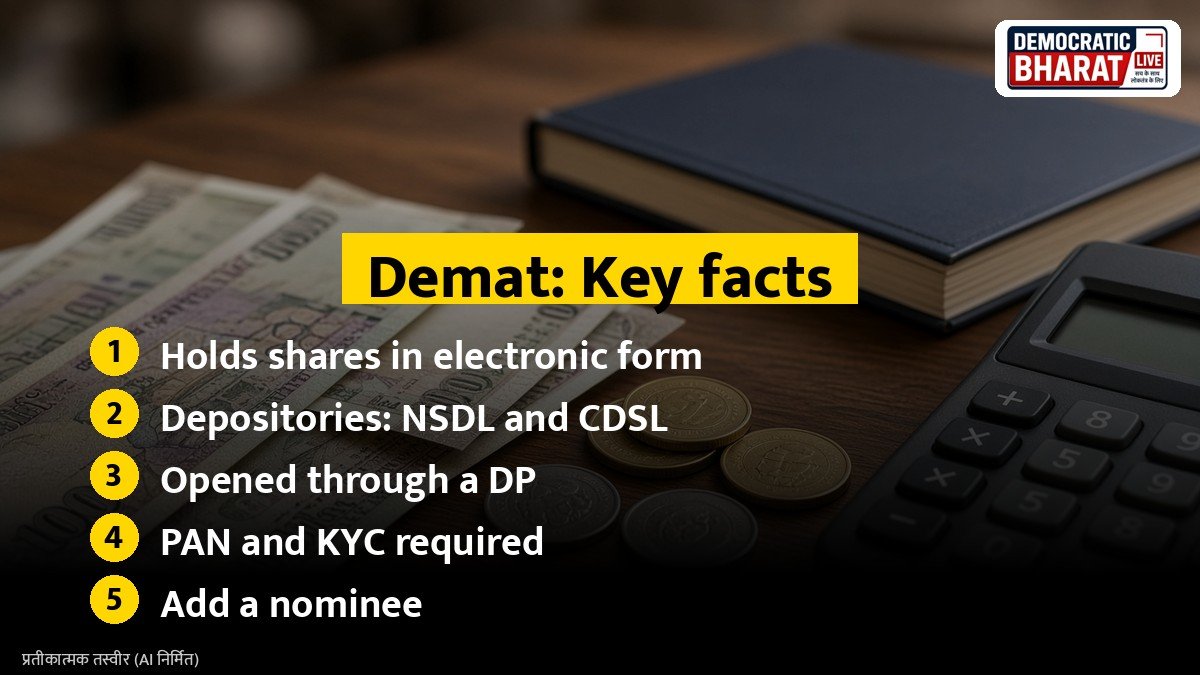
Demat is short for dematerialised. Shares were once issued as paper certificates. Today they are held electronically in demat accounts. India has two depositories that hold these securities:
- National Securities Depository Limited (NSDL).
- Central Depository Services (India) Limited (CDSL).
You open a demat account through a Depository Participant (DP), such as a stock broker or a bank, registered with SEBI.
Demat and trading accounts
- A demat account holds your securities.
- A trading account is used to place buy and sell orders on stock exchanges.
Most brokers open both together.
Documents needed
- PAN card, which is mandatory.
- Aadhaar for address proof and e-KYC.
- Bank account details with a cancelled cheque or bank statement.
- Photograph and signature.
- Income proof, if you want to trade in derivatives.
Also Read: Sukanya Samriddhi Account: Rules, Deposit Limits, Tax Benefits and When the Money Can Be Withdrawn | HRA Exemption Explained: How to Calculate Tax Free House Rent Allowance and Documents Needed
Steps to open
- Choose a SEBI registered broker or bank DP. Compare charges and services.
- Fill the online form with PAN, Aadhaar and bank details.
- Complete in person verification through a video call.
- E-sign the application with Aadhaar OTP.
- Add a nominee, or choose to opt out formally.
Your account is usually opened within a few days.
Charges
- Account opening charges, which many brokers waive.
- Annual maintenance charges (AMC).
- Transaction charges when shares are sold.
- Brokerage on trades.
Basic Services Demat Account
SEBI allows a Basic Services Demat Account (BSDA) with low or no annual charges for small investors. In 2024, SEBI raised the BSDA eligibility limit to holdings worth up to Rs 10 lakh. Ask your DP if you qualify.
Safety tips
- Deal only with SEBI registered brokers.
- Never share your login, OTP or demat details with anyone.
- Check the monthly Consolidated Account Statement from NSDL or CDSL.
- Beware of tips on social media promising guaranteed returns.
- Use the SCORES portal of SEBI to file complaints.
Settlement
Indian stock markets follow T+1 settlement, which means shares and money are settled one working day after the trade.
Closing or transferring an account
You can close a demat account by submitting a closure request to your DP, after moving any holdings to another demat account. Transfers between accounts in your own name can be done through a delivery instruction slip or online through the depository’s facility.
Bottom line
Opening a demat account is quick and paperless. Choose a registered DP, compare charges, add a nominee and protect your login details.
Source / स्रोत: Securities and Exchange Board of India, NSDL, CDSL