The Attorney General for India is the highest law officer of the country and the chief legal adviser to the central government. The office is created by the Constitution. Here is how it works.
Constitutional basis
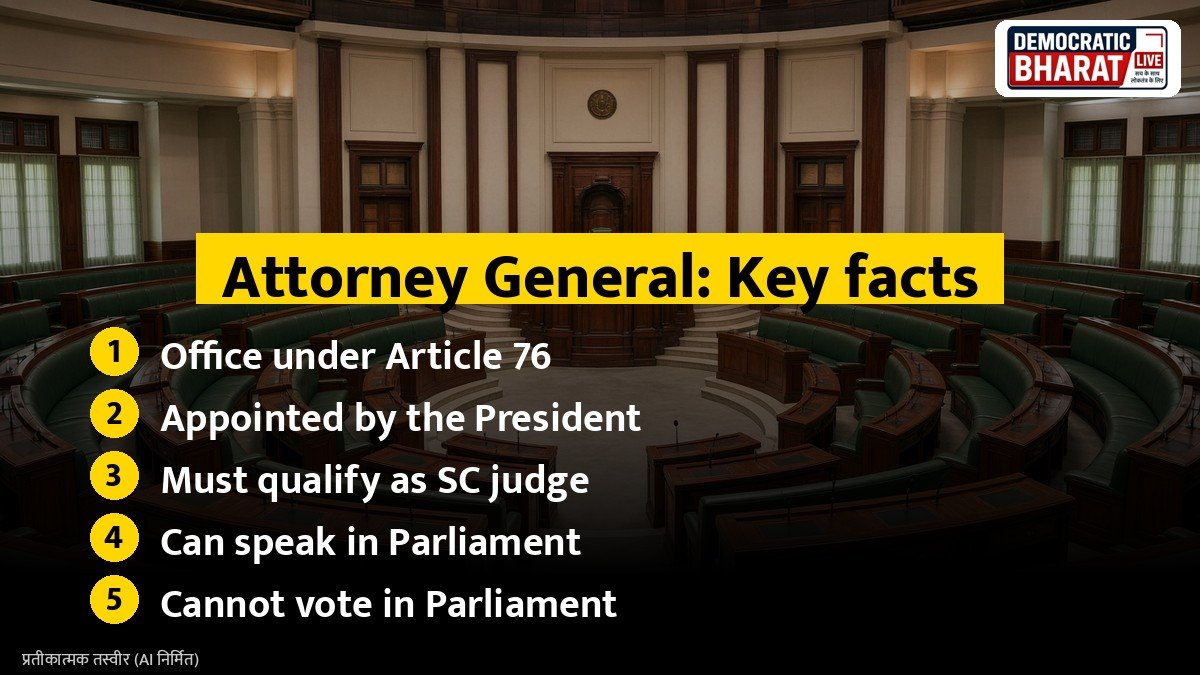
Article 76 of the Constitution provides for the office of the Attorney General. The AG is appointed by the President on the advice of the Union Cabinet.
Qualifications
The Attorney General must be qualified to be appointed a judge of the Supreme Court. This means the person must be an Indian citizen and either:
- Have been a High Court judge for five years, or
- Have been a High Court advocate for ten years, or
- Be a distinguished jurist in the opinion of the President.
Term
The Constitution does not fix a term. The AG holds office during the pleasure of the President and receives remuneration decided by the President. In practice, the AG usually resigns when the government changes. R Venkataramani took office as Attorney General in October 2022.
Also Read: Role of the Governor in India: Appointment, Powers Over Bills and the Supreme Court’s Rulings | Prime Minister of India: How the PM Is Appointed, Powers and Accountability to Parliament
Duties
- Give advice to the Government of India on legal matters referred by the President.
- Perform other legal duties assigned by the President.
- Appear for the Government of India in the Supreme Court and High Courts in cases where the government is a party.
- Represent the government in references made by the President to the Supreme Court under Article 143.
Rights in Parliament
Under Article 88, the AG has the right to speak and take part in the proceedings of both Houses of Parliament, joint sittings and parliamentary committees, but does not have the right to vote.
Rights in courts
The AG has the right of audience in all courts in India.
Limits
The AG is not a full time government servant and can do private practice, but cannot advise or appear against the Government of India, or defend accused persons in criminal cases without permission.
Other law officers
- Solicitor General of India: the second highest law officer, who assists the AG.
- Additional Solicitors General: assist in courts across the country.
- Advocate General: the state level law officer under Article 165, appointed by the Governor.
History
M C Setalvad was the first Attorney General of India, serving from 1950 to 1963, the longest tenure so far.
Bottom line
The Attorney General is the Centre’s top legal adviser and lawyer, with the unique right to speak in Parliament without voting. The office links the executive, legislature and judiciary.
Source / स्रोत: Constitution of India, Legislative Department, Department of Legal Affairs, Ministry of Law and Justice, Supreme Court of India