
The Finance Commission is a constitutional body that recommends how tax revenue collected by the Centre should be shared with the states. Its recommendations shape the budgets of every state for five years. Here is how it works.
Constitutional basis
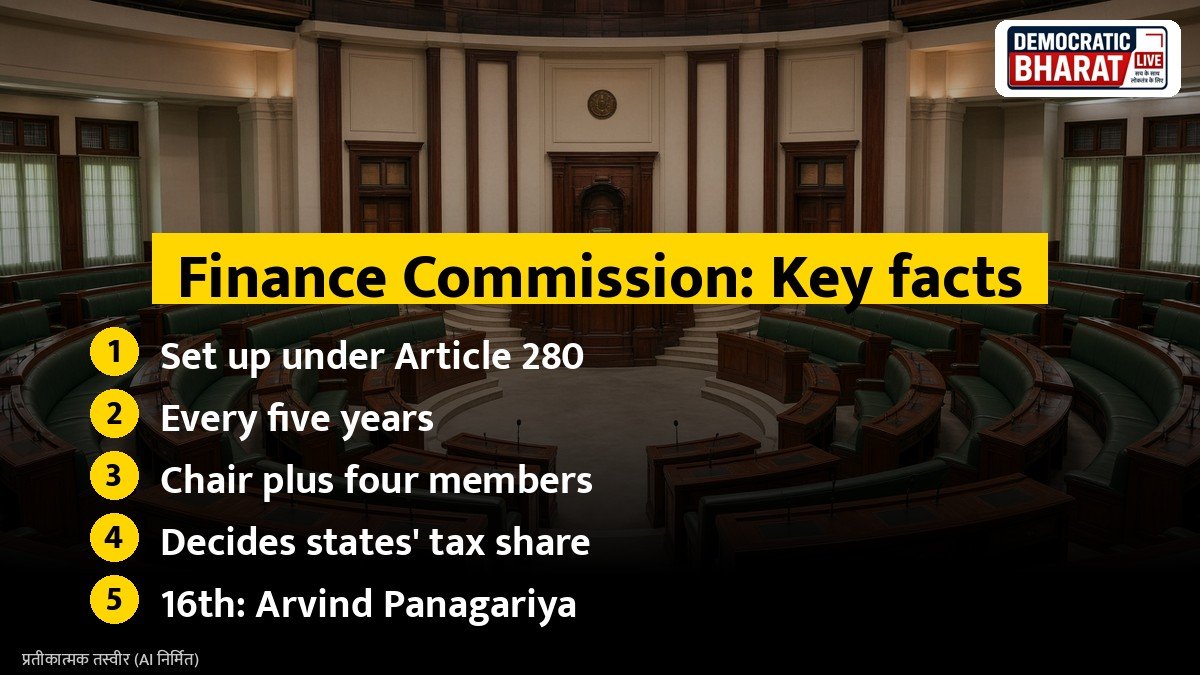
Article 280 of the Constitution requires the President to set up a Finance Commission every five years, or earlier if needed. The Finance Commission (Miscellaneous Provisions) Act, 1951 lays down qualifications and procedures.
Composition
The commission has a chairperson and four other members, appointed by the President. The chair must have experience in public affairs, and members are chosen from experts in finance, economics, administration or law.
What it decides
- Vertical devolution: the share of the divisible pool of central taxes that goes to states as a whole. The 15th Finance Commission set this at 41 percent.
- Horizontal devolution: how that share is divided among states, using criteria such as population, area, income distance, forest cover and demographic performance.
- Grants in aid to states that need extra help, including revenue deficit grants.
- Grants for local bodies, such as panchayats and municipalities.
- Other matters referred by the President, such as disaster management funding.
Also Read: Election Commission of India Explained: Powers, How the CEC Is Appointed and the 2023 Law | Role of the Governor in India: Appointment, Powers Over Bills and the Supreme Court’s Rulings
Divisible pool
Not all central revenue is shared. Cesses and surcharges collected by the Centre are outside the divisible pool. States have often argued that the rising share of cesses and surcharges reduces what they receive.
Are recommendations binding
The commission’s recommendations are advisory, but in practice the government accepts most of them. Its report, along with an explanatory memorandum on action taken, is laid before Parliament.
The 16th Finance Commission
The 16th Finance Commission was set up on 31 December 2023 with economist Arvind Panagariya, former Vice Chairman of NITI Aayog, as its chairperson. It covers the five years from 2026-27 to 2030-31. Its recommendations decide the states’ share in central taxes for this period. Check the commission’s report and the government’s action taken note in Parliament for the final figures.
Why it matters
Many states depend on central transfers for a large part of their revenue. The formula decides how much money each state gets for schools, hospitals, roads and welfare. Debates over criteria, such as how much weight to give population, often divide richer and poorer states.
State Finance Commissions
Under Articles 243-I and 243-Y, states must set up their own finance commissions to recommend how state revenue is shared with panchayats and municipalities.
Bottom line
The Finance Commission is the umpire of India’s fiscal federalism. Its five year formula decides how central taxes flow to states and local bodies.
Source / स्रोत: Finance Commission of India, Ministry of Finance, Constitution of India, Legislative Department