
The United Nations Environment Programme (UNEP) is the leading global authority on the environment. It sets the environmental agenda, supports countries and pushes for action on climate, nature and pollution. Here is a simple explainer.
History
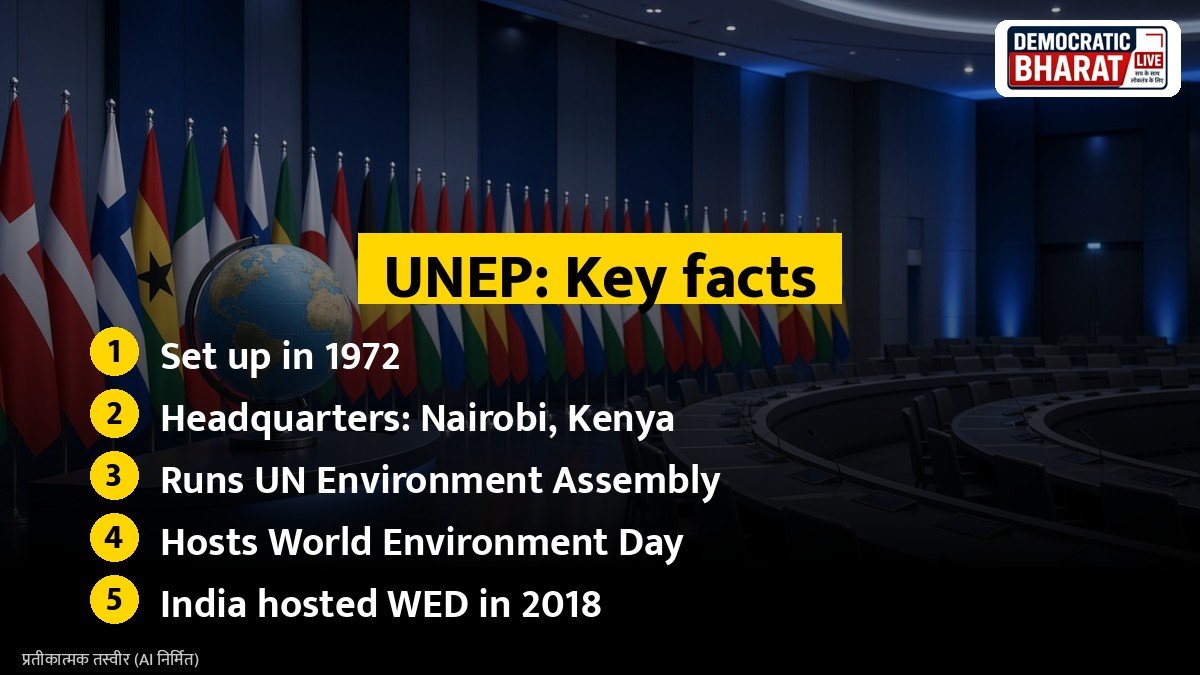
UNEP was created in 1972 after the United Nations Conference on the Human Environment in Stockholm. It was one of the first UN bodies focused on the environment. Its headquarters are in Nairobi, Kenya, making it one of the few UN agencies based in Africa.
What UNEP does
UNEP works on three main crises, which it calls the triple planetary crisis:
- Climate change.
- Loss of nature and biodiversity.
- Pollution and waste.
It does this through scientific reports, policy advice to governments and support for global agreements.
Key reports
- The Emissions Gap Report, which compares countries’ climate pledges with what is needed.
- The Global Environment Outlook.
- The Adaptation Gap Report.
Also Read: What Is BRICS? Members, New Development Bank and India’s Role as Chair in 2026 | What Is the Quad? How India, the US, Japan and Australia Work Together in the Indo Pacific
Treaties and bodies linked to UNEP
UNEP hosts or supports the secretariats of several environmental agreements, including the Convention on Biological Diversity, the Convention on International Trade in Endangered Species (CITES) and the Montreal Protocol on the ozone layer. UNEP and the World Meteorological Organization set up the Intergovernmental Panel on Climate Change (IPCC) in 1988.
UN Environment Assembly
The UN Environment Assembly (UNEA) is the world’s highest decision making body on the environment, and all UN member states are members. In 2022, UNEA agreed to start negotiations on a global treaty to end plastic pollution.
World Environment Day
UNEP leads World Environment Day on 5 June every year. Each year has a theme and a host country. India hosted World Environment Day in 2018 with the theme Beat Plastic Pollution.
India and UNEP
- India is an active member and contributes to UNEP.
- Prime Minister Narendra Modi received the UN Champions of the Earth award, UNEP’s top environmental honour, in 2018.
- India works with UNEP on issues such as clean air, plastics and sustainable lifestyles, including the Mission LiFE initiative.
Funding
UNEP is funded by voluntary contributions from countries and partners, along with a small share of the UN regular budget.
Bottom line
UNEP is the UN’s environmental voice. Its science and treaties shape how countries, including India, tackle climate change, nature loss and pollution.
Source / स्रोत: United Nations Environment Programme, Ministry of Environment, Forest and Climate Change, United Nations