The Kisan Credit Card (KCC) scheme was introduced in 1998 to give farmers timely and affordable credit for cultivation and related needs. It is offered by commercial banks, regional rural banks, small finance banks and cooperative banks under guidelines of the Reserve Bank of India and NABARD.
What the KCC covers
- Short term credit for crop cultivation
- Post harvest expenses
- Produce marketing loans
- Household consumption needs of farmers
- Working capital for maintaining farm assets
- Investment credit for agriculture and allied activities
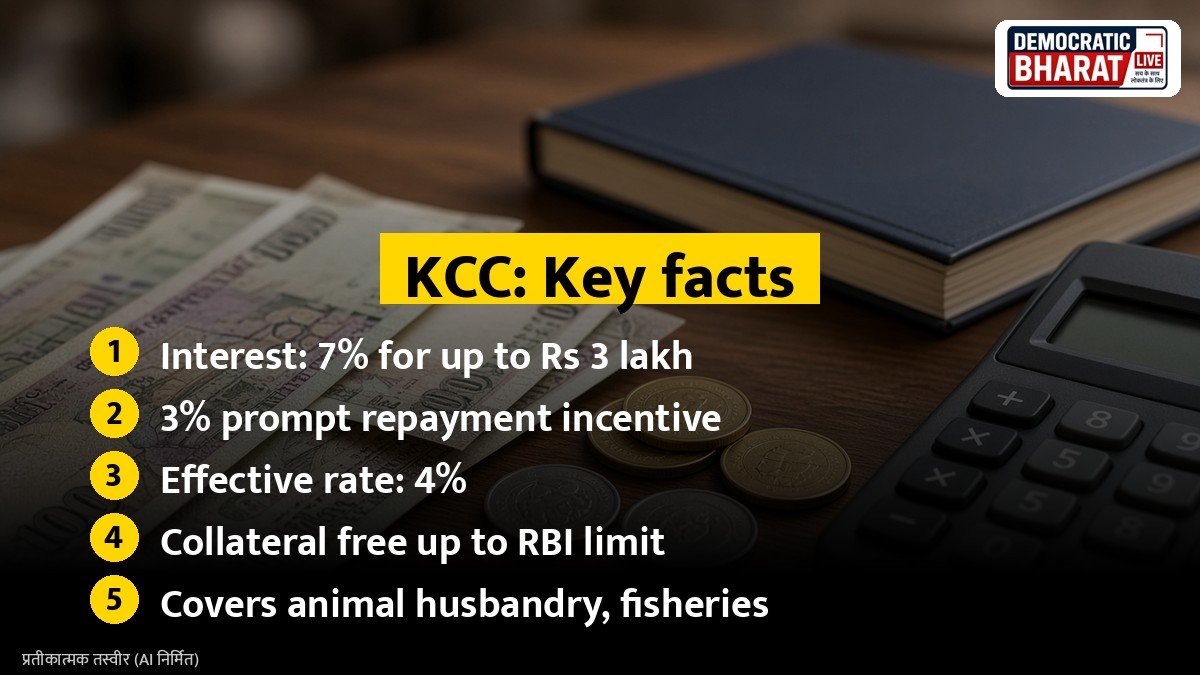
Since 2018-19, KCC has also been extended to farmers in animal husbandry and fisheries.
Interest rate and subvention
Under the Modified Interest Subvention Scheme, short term crop loans up to Rs 3 lakh through KCC are given at 7 percent interest. Farmers who repay on time get an additional 3 percent prompt repayment incentive, bringing the effective rate down to 4 percent. The Union Budget 2025-26 announced raising the KCC loan limit under this scheme to Rs 5 lakh. Check with your bank for the current limit on which subvention applies.
Loan limit
The limit is fixed based on the scale of finance for crops in the district, the area cultivated, and other needs. The RBI allows collateral free KCC loans up to a set limit, which was raised to Rs 2 lakh from January 2025. For loans above this, banks may ask for security.
Also Read: Soil Health Card Scheme: How Farmers Can Get Soil Tested and Use the Report to Cut Fertiliser Costs | How MSP Is Fixed in India: Role of CACP, the 1.5 Times Cost Formula and Rabi Crops Covered
Who can apply
- Owner cultivators
- Tenant farmers, oral lessees and sharecroppers
- Self help groups or joint liability groups of farmers
- Farmers in animal husbandry and fisheries
Documents
- Filled application form
- Identity and address proof, such as Aadhaar
- Land records or proof of cultivation
- Passport size photographs
How to apply
- Visit your bank branch, or apply online if your bank offers it.
- PM-KISAN beneficiaries can use the simple one page KCC form available on the PM-KISAN portal and submit it to their bank.
- The bank verifies details and sanctions the limit, usually within a few weeks.
Validity and benefits
A KCC is generally valid for five years with annual review. Many banks issue a RuPay debit card with the KCC. Crops financed through KCC can be insured under PM Fasal Bima Yojana.
Advice for farmers
Before sowing, selling or storing your crop, check the latest information with your district agriculture department, Krishi Vigyan Kendra or mandi committee.
Bottom line
The Kisan Credit Card offers some of the cheapest credit available to farmers. Repay on time to get the full benefit of the 4 percent effective interest rate.
Source / स्रोत: Reserve Bank of India: KCC master direction, NABARD, PM-KISAN: KCC