A bounced cheque is not only a banking problem. Under Indian law, it can lead to a criminal case against the person who issued it. The rules are set out in Section 138 of the Negotiable Instruments Act, 1881. Here is a simple guide.
When does Section 138 apply
A case under Section 138 can be filed when:
- A cheque was issued to pay a legally enforceable debt or liability.
- It was presented to the bank within its validity period, which is three months from the date on the cheque.
- It was returned unpaid because of insufficient funds or because it exceeded the arrangement with the bank.
Cheques given as a gift or donation do not fall under this section.
The timeline
- Cheque returned: the bank gives a return memo with the reason.
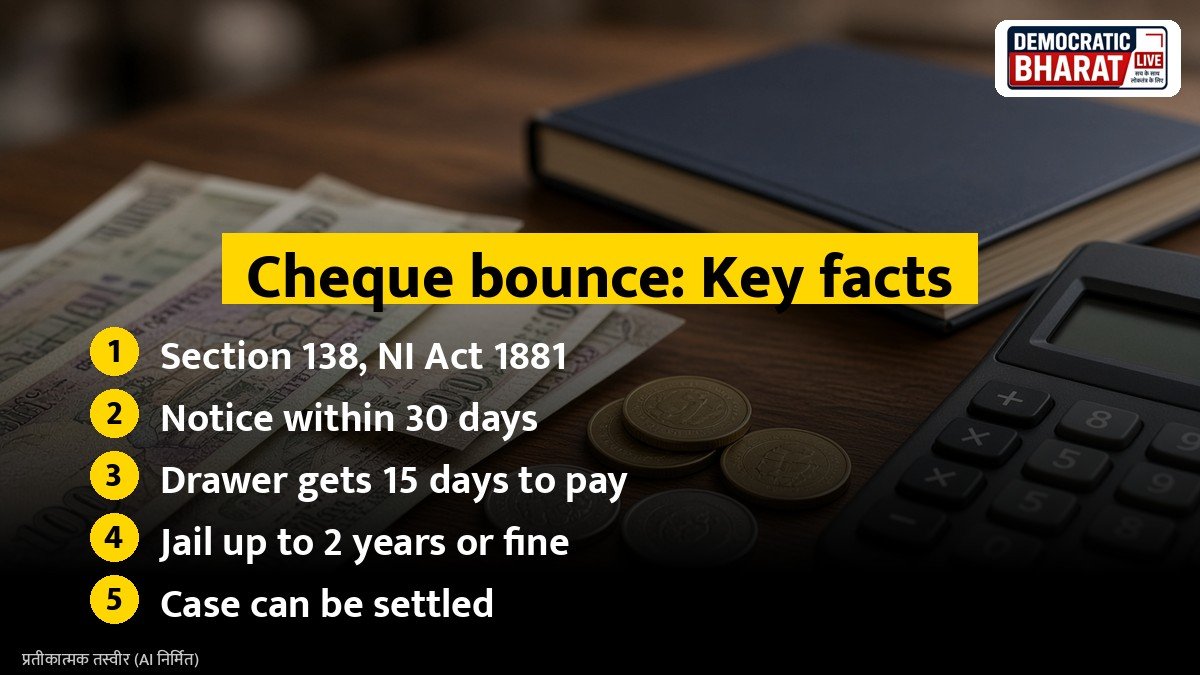
- Legal notice: the payee must send a written notice to the drawer within 30 days of receiving information about the dishonour, demanding payment.
- Time to pay: the drawer gets 15 days from receiving the notice to pay the amount.
- Complaint: if the drawer does not pay, the payee can file a complaint in the magistrate’s court within one month after the 15 day period ends.
The court can accept a delayed complaint if there is sufficient reason.
Where to file
The complaint is filed in the court that has jurisdiction over the bank branch where the payee presented the cheque, as per the 2015 amendment to the law.
Also Read: PPF Account Rules: Deposit Limit, 15 Year Lock In, Loan, Partial Withdrawal and Extension Explained | Deposit Insurance Explained: How DICGC Covers Your Bank Savings and FDs up to Rs 5 Lakh
Penalty
If found guilty, the drawer can face:
- Imprisonment of up to two years, or
- A fine of up to twice the cheque amount, or
- Both.
Interim compensation
Under Section 143A, added in 2018, the court can order the drawer to pay interim compensation of up to 20 percent of the cheque amount while the case is pending.
Settlement
Cheque bounce cases are compoundable under Section 147, which means the parties can settle at any stage. The Supreme Court has encouraged early settlement and has laid down guidelines to speed up these cases. Many cases are settled in Lok Adalats.
Bank charges
Banks also charge a fee for cheque returns, for both the drawer and sometimes the depositor. Check your bank’s schedule of charges.
Tips to avoid trouble
- Issue cheques only when you have enough balance.
- Do not sign blank cheques.
- Keep records of all cheques issued and received.
- Respond to legal notices promptly.
Bottom line
A bounced cheque can become a criminal case if notice and payment deadlines are missed. Act quickly, follow the 30 day and 15 day timelines and consider settlement where possible.
Source / स्रोत: Negotiable Instruments Act, 1881, India Code, Reserve Bank of India, Supreme Court of India