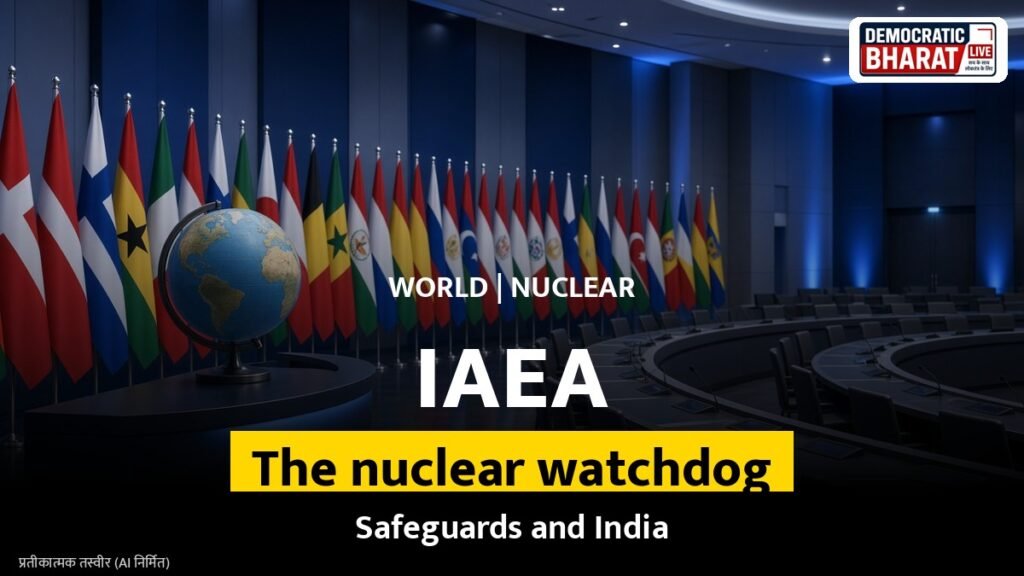
The International Atomic Energy Agency (IAEA) is the world’s main body for cooperation on nuclear energy. It is often called the UN nuclear watchdog because it checks that nuclear material is not diverted to weapons. Here is a simple guide.
How it began
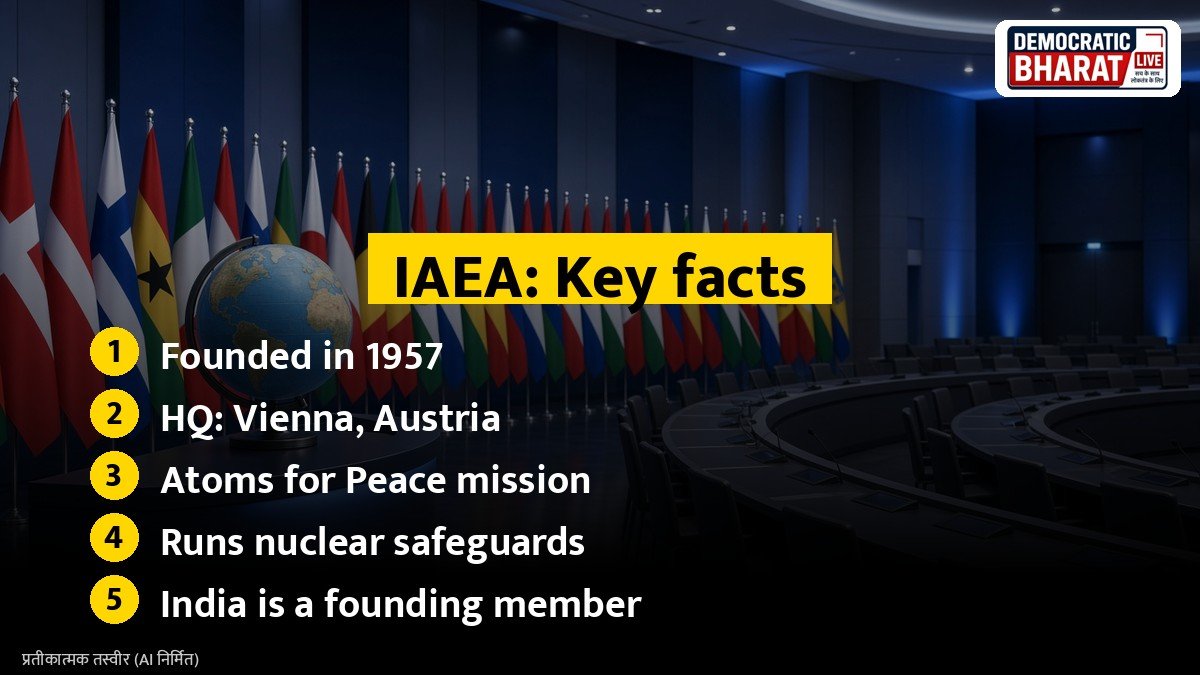
The IAEA was set up in 1957, inspired by US President Dwight Eisenhower’s Atoms for Peace speech at the United Nations in 1953. Its headquarters is in Vienna, Austria. It is an autonomous organisation that reports to the UN General Assembly and Security Council.
Members
The IAEA has more than 175 member states. India was among the founding members in 1957.
Main roles
- Safeguards and verification: checking that countries use nuclear material only for peaceful purposes.
- Safety and security: setting standards for safe operation of nuclear facilities and protection of nuclear material.
- Technology and development: helping countries use nuclear science in medicine, agriculture, water and industry.
Also Read: What Is BRICS? Members, New Development Bank and India’s Role as Chair in 2026 | What Is the SCO? Members, Aims and India’s Role in the Shanghai Cooperation Organisation
How safeguards work
- Countries sign safeguards agreements with the IAEA.
- They declare their nuclear material and facilities.
- IAEA inspectors visit sites, check records, install cameras and seals and take samples.
- Under the Treaty on the Non Proliferation of Nuclear Weapons (NPT), non nuclear weapon states must accept comprehensive safeguards on all their nuclear activities.
- An Additional Protocol gives inspectors wider access.
IAEA in the news
The IAEA has been central to monitoring Iran’s nuclear programme, inspecting facilities in North Korea in the past, and assessing safety at Ukraine’s Zaporizhzhia nuclear plant during the war. Its Director General is Rafael Grossi of Argentina, who took office in 2019.
India and the IAEA
- India has not signed the NPT, arguing it is discriminatory.
- After the India US civil nuclear deal, India signed an India specific safeguards agreement with the IAEA in 2009, following IAEA Board approval in 2008.
- In 2008, the Nuclear Suppliers Group granted India a waiver to engage in civil nuclear trade.
- India placed civilian nuclear reactors under IAEA safeguards, while its strategic programme remains outside.
- India also signed an Additional Protocol, which came into force in 2014.
Nuclear energy in India
India runs nuclear power plants through the Nuclear Power Corporation of India and plans to expand nuclear capacity, including small modular reactors, as part of its clean energy goals.
Bottom line
The IAEA promotes peaceful nuclear energy and checks that it stays peaceful. India, a founding member, works with it on safety and safeguards for its civilian nuclear programme.
Source / स्रोत: International Atomic Energy Agency, Department of Atomic Energy, Ministry of External Affairs