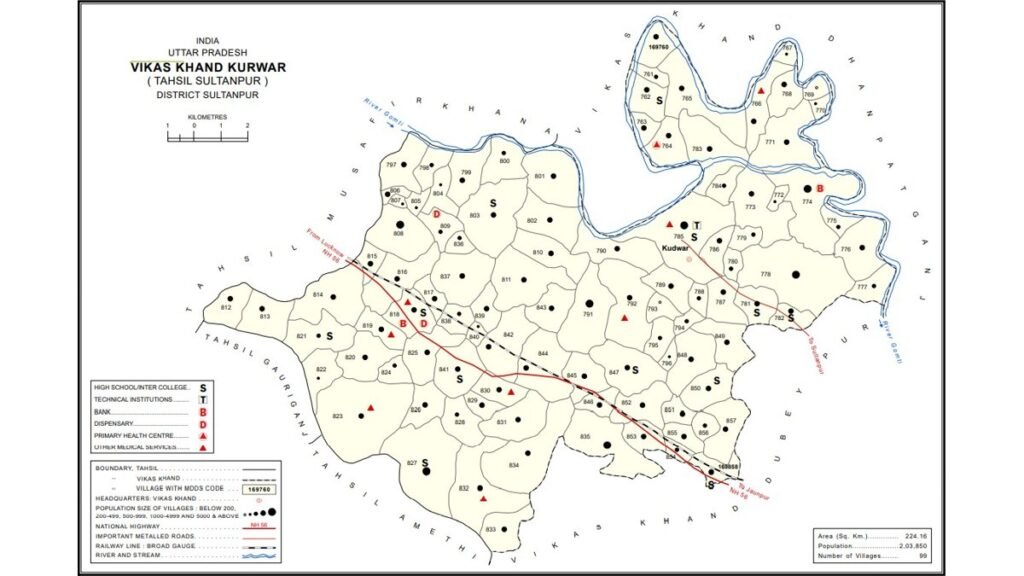
In rural India, government schemes reach villages mainly through a unit called the development block. While the tehsil is the unit for revenue and land records, the block is the unit for rural development and panchayat related schemes. The official website of the Sultanpur district administration, sultanpur.nic.in, lists 14 development blocks on its page on subdivisions and blocks.
The 14 blocks of Sultanpur
In the order given on the official list, the blocks are: Dubeypur, Kurebhar, Kurwar, Bhadaiyan, Lambhua, Pratappur Kamaicha, Jaisinghpur, Motigarpur, Karaundi Kalan, Kadipur, Dostpur, Akhandnagar, Dhanpatganj and Baldirai. Four of these names, Lambhua, Jaisinghpur, Kadipur and Baldirai, are also names of tehsils, but a tehsil and a block are different units with different boundaries and functions.
Spellings of these names vary in everyday use and in different documents. While filling a government form, use the name exactly as it appears in the portal’s list. In online forms, choosing the correct block from the drop down menu matters, because the application is routed to that block office.
How a block is organised
Uttar Pradesh follows a three tier panchayati raj system: the gram panchayat at the village level, the kshetra panchayat at the block level and the zila panchayat at the district level. The elected head of the kshetra panchayat is called the block pramukh. On the administrative side, the Block Development Officer, or BDO, heads the block office. Assistant development officers, village development officers and gram panchayat officers work under this structure.
Schemes handled through blocks
The block office is the working centre for many central and state schemes. Under the Mahatma Gandhi National Rural Employment Guarantee Scheme, job cards and demand for work are handled at the gram panchayat and block level. Verification of beneficiaries and monitoring of instalments under Pradhan Mantri Awas Yojana Gramin also happen at the block level. Village sanitation under Swachh Bharat Mission Gramin and self help groups under the National Rural Livelihood Mission run through the same structure.
Before applying for a scheme, check whether the application is online or through the gram panchayat. For several schemes, beneficiary lists are read out in open meetings of the gram sabha. Attending these meetings is one of the best ways for villagers to learn about their entitlements and raise objections if someone eligible has been left out.
Before visiting a block office
Carry Aadhaar, a bank passbook, a copy of the family register and earlier papers related to the scheme. Payments under schemes such as MGNREGS go directly to bank accounts, so the account should be linked with Aadhaar. For a complaint, first speak to the gram panchayat officer or village development officer, then the BDO office, and if needed use the state’s Jansunwai portal.
Where to check block level data online
The eGramSwaraj portal of the Union Ministry of Panchayati Raj, egramswaraj.gov.in, shows development plans and spending of gram panchayats. Users can select the state, district, block and gram panchayat to see which works were planned. Details of MGNREGS works and payments can also be checked block wise and panchayat wise on nrega.nic.in. These portals allow villagers to keep an eye on what is being done in their area and to ask informed questions at gram sabha meetings.
Blocks can be reorganised by government order, and the district website page appears to have been updated some years ago. To confirm the block of a particular village, it is better to check current official records, such as panchayat election lists or the portal of the state’s Rural Development department.
In short, the Sultanpur district administration lists 14 development blocks: Dubeypur, Kurebhar, Kurwar, Bhadaiyan, Lambhua, Pratappur Kamaicha, Jaisinghpur, Motigarpur, Karaundi Kalan, Kadipur, Dostpur, Akhandnagar, Dhanpatganj and Baldirai. For rural schemes, MGNREGS and housing, the block office is the first step on the government ladder.
Source: District Sultanpur, Tehsil list, District Sultanpur, Subdivision and Blocks, UP Bhulekh