Boxing has given India Olympic medals through Vijender Singh (2008), Mary Kom (2012) and Lovlina Borgohain (2020), along with many world championship medals. Olympic style boxing, also called amateur boxing, has rules that differ from professional boxing. Here is a guide to the main boxing rules.
Who governs the sport
World Boxing was recognised by the International Olympic Committee in 2025 as the international federation for boxing, after the IOC withdrew recognition from the earlier body, the IBA. In India, the Boxing Federation of India (BFI) governs the sport.
Bout format
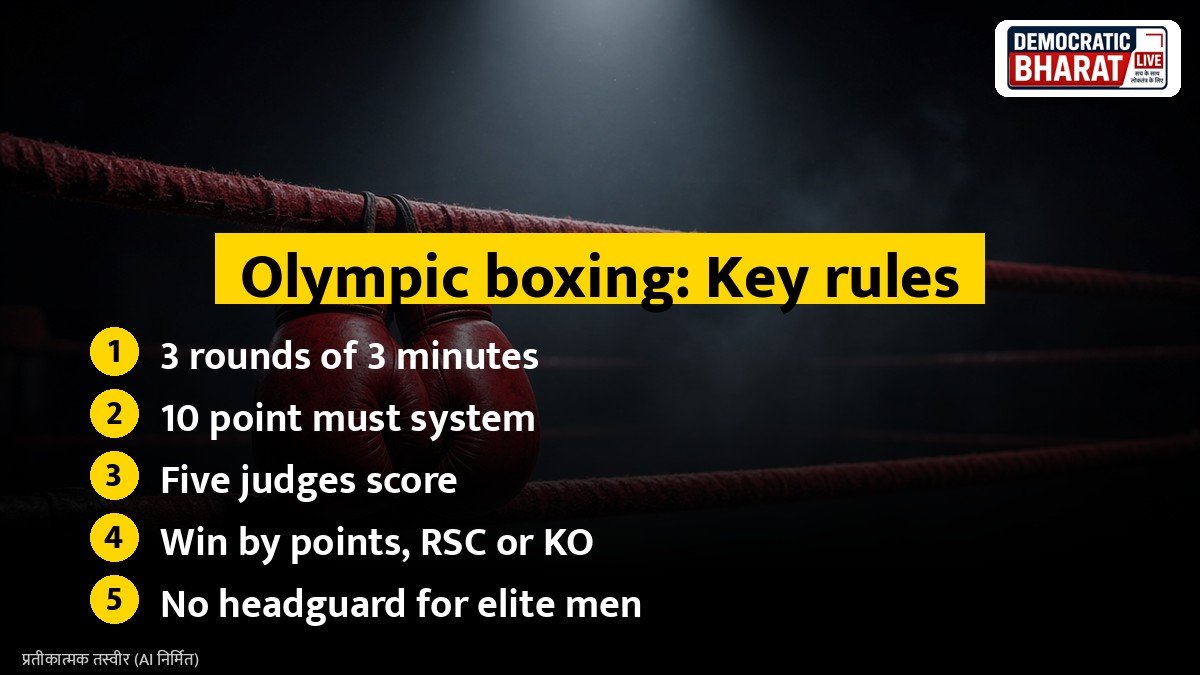
- Elite bouts have three rounds of three minutes each.
- There is a one minute rest between rounds.
- Boxers wear gloves of a weight set for their weight class.
- Elite men box without headguards, while some categories, such as youth and in many events women, follow rules set by the federation for headguards.
The 10 point must system
Five judges score each round. The boxer judged to have won the round gets 10 points, and the other gets 9 or fewer. Judges consider:
- the number of quality blows on the target area,
- domination of the bout through technique and tactics, and
- competitiveness.
After three rounds, each judge’s scorecard picks a winner, and the bout is decided by the majority of judges.
Also Read: Badminton Rules Explained: 21 Point Rally Scoring, Service Rules and Faults Every Player Should Know | Kabaddi Rules Explained: Raid, Tackle, Bonus Point and Super Tackle in Simple Words
Ways to win
- On points, by judges’ decision (unanimous or split).
- RSC (Referee Stops Contest), when the referee decides a boxer is outclassed or cannot continue safely.
- Knockout, when a boxer cannot continue after a count of 10.
- Disqualification of the opponent for serious fouls.
- Walkover, if the opponent does not appear.
Fouls
Common fouls include hitting below the belt, holding, hitting with an open glove, head butting, hitting the back of the head or neck, and ducking below the opponent’s belt. The referee can warn a boxer, and a warning leads to a point deduction on the judges’ scorecards.
Weight classes
Boxers compete in weight categories so that bouts are fair. The number and limits of categories at the Olympics have changed over the years, and they are set separately for men and women. Check World Boxing’s official list for current categories.
Weigh in and medical checks
Boxers must weigh in and pass medical checks before competition. Safety is a priority, and doctors are present at ringside.
Bottom line
Olympic boxing rules reward clean, scoring punches and ring control over three rounds. Understanding the 10 point must system helps fans follow close bouts.
Source / स्रोत: World Boxing, Boxing Federation of India, International Olympic Committee