Mallakhamb is one of India’s most striking traditional sports. Athletes perform fast holds, balances and twists on a vertical wooden pole or a hanging rope. Once a training aid for wrestlers, it is now a competitive sport with national championships. Here is a simple guide.
What the name means
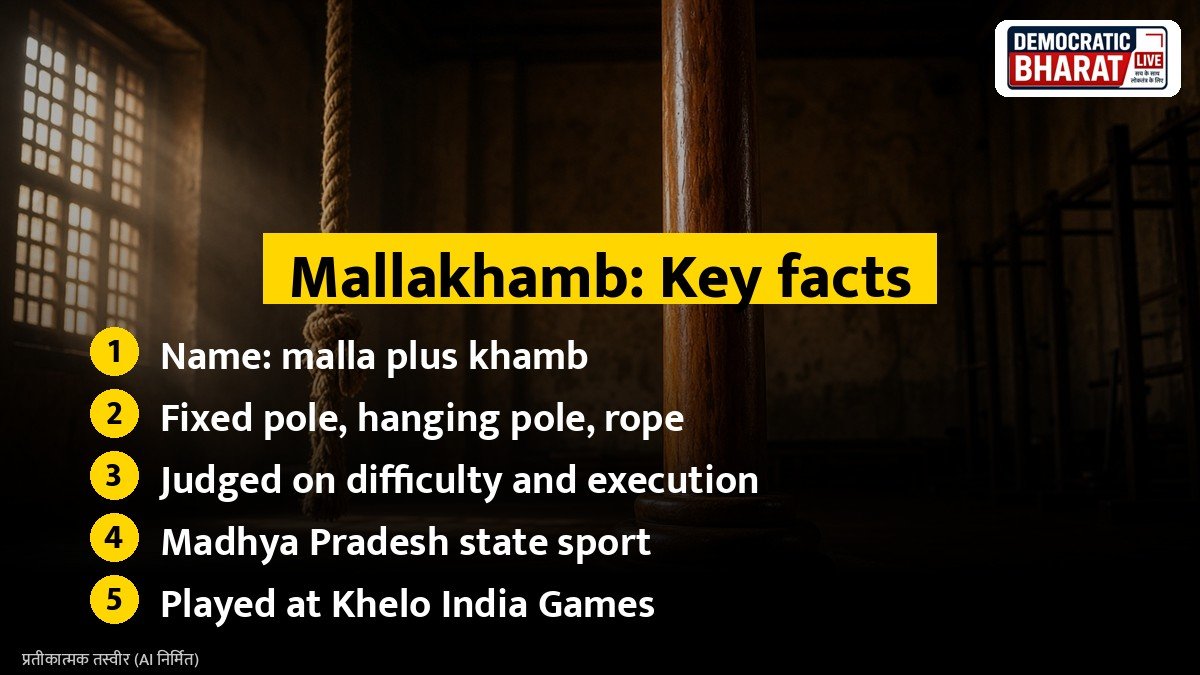
The word comes from malla, meaning wrestler or gymnast, and khamb, meaning pole. The sport was used by wrestlers to build grip, flexibility and core strength. Its revival is widely credited to Balambhatt Dada Deodhar, who trained in the court of Peshwa Bajirao II in the early nineteenth century in Maharashtra.
Main types
- **Pole mallakhamb:** a fixed wooden pole, usually made of sheesham, about 2.6 metres above the ground, smooth and slightly tapered at the top. It is the most common form.
- **Hanging mallakhamb:** a shorter pole hung from hooks and chains, so it swings while the athlete performs.
- **Rope mallakhamb:** a cotton rope on which athletes, often girls and women, perform yoga like poses and wraps without knots.
How a routine works
A competitor performs a timed routine of mounts, catches, balances and dismounts. Typical elements include climbing, inverted holds, splits around the pole and quick spins. The routine must flow smoothly without long pauses.
Also Read: Polo Rules Explained: Chukkas, Handicaps, Line of the Ball and India’s Polo History | Olympic Shooting Events Explained: Rifle, Pistol and Shotgun Formats and India’s Medal History
How it is judged
Judging is similar to gymnastics. A panel scores each routine on difficulty, combination and execution. Points are lost for falls, loss of grip, poor body line and incomplete moves. Difficult elements done cleanly earn the highest marks.
Growth of the sport
- The Mallakhamb Federation of India organises national championships.
- Madhya Pradesh declared mallakhamb its state sport in 2013.
- The sport has been part of the Khelo India Youth Games.
- Clubs now exist in several countries, and international championships have been held in Mumbai.
Benefits
Mallakhamb builds grip strength, flexibility, balance, focus and body control. Coaches say young children can start with basic holds under supervision.
Safety
- Always train under a qualified coach.
- Use mats or soft sand below the pole.
- Warm up well and build strength gradually.
Bottom line
Mallakhamb blends strength, flexibility and art. Rooted in Indian wrestling tradition, it is now a judged sport with a growing national and global following.
Source / स्रोत: Mallakhamb Federation of India, Khelo India, Ministry of Youth Affairs and Sports, Sports Authority of India