Judo is a Japanese martial art and Olympic sport built on throws, hold downs and submission techniques. Its name means the gentle way. The international rules are set by the International Judo Federation (IJF). Here is a simple guide.
Origins
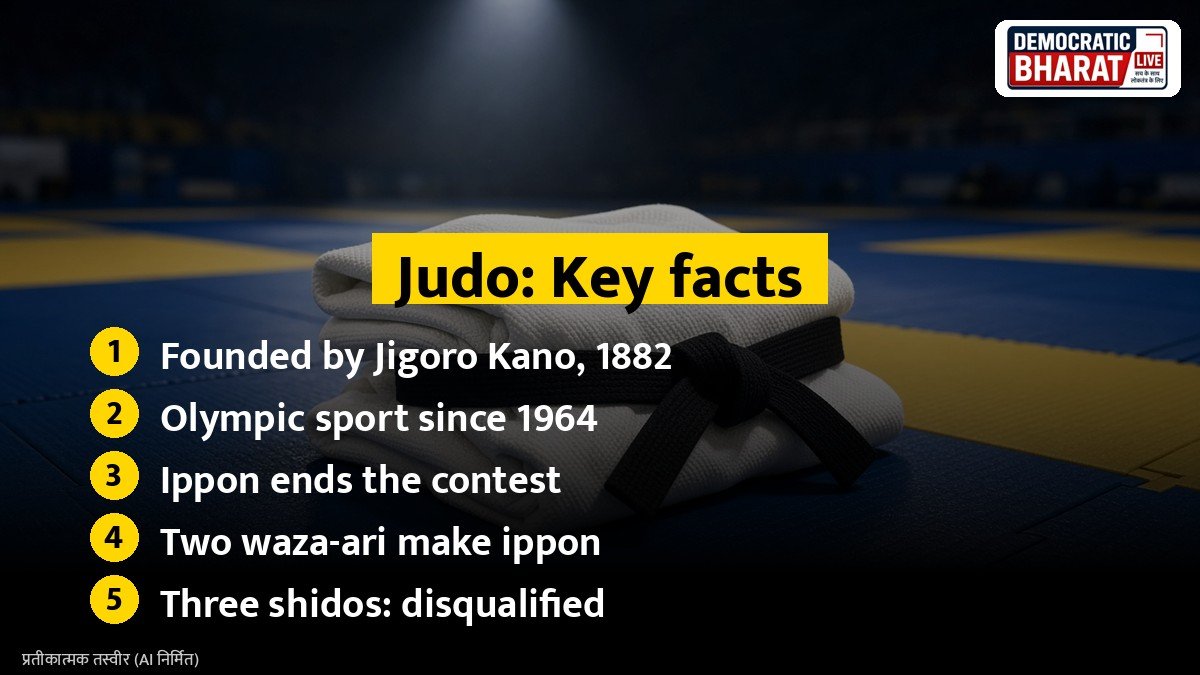
Judo was founded by Jigoro Kano in Japan in 1882, when he set up the Kodokan school. It became an Olympic sport for men at the 1964 Tokyo Games, and women’s judo joined the Olympics in 1992.
The contest
- Two athletes, called judoka, compete on a mat called a tatami.
- One wears a white judogi and the other a blue judogi in international events.
- A regular contest lasts four minutes for both men and women.
- Athletes compete in weight categories.
Scores
Ippon
Ippon is the highest score and ends the contest at once. It is given for:
- A throw that lands the opponent largely on the back with force, speed and control.
- A hold down, called osaekomi, kept for 20 seconds.
- A submission, when the opponent taps out from an armlock or strangle.
Waza-ari
Waza-ari is given for a throw that lacks one of the elements of an ippon, or for a hold down kept for 10 seconds. Under current IJF rules, two waza-ari add up to an ippon and win the contest.
The yuko score was removed from the rules in 2017.
Also Read: Badminton Rules Explained: 21 Point Rally Scoring, Service Rules and Faults Every Player Should Know | Olympic Boxing Rules Explained: Rounds, the 10 Point Must System, Weight Classes and How Bouts Are Won
Golden score
If scores are level at the end of regular time, the contest goes to golden score. There is no time limit, and the first athlete to score, or the one whose opponent gets a penalty, wins.
Penalties
- Minor rule breaks, such as passivity, avoiding grips or stepping out, lead to a shido.
- Three shidos result in hansoku-make, which means losing the contest.
- Serious offences, such as dangerous actions, can lead to direct hansoku-make.
Values of judo
Judo stresses respect, discipline and mutual benefit. Athletes bow before and after every contest. Kano’s guiding ideas were maximum efficiency and mutual welfare and benefit.
Judo in India
The Judo Federation of India governs the sport. Indian judoka have won medals at the Commonwealth Games and Asian events, including Tulika Maan’s silver at the 2022 Birmingham Commonwealth Games. Judo is also part of Khelo India programmes.
Why learn judo
- Builds strength, balance and flexibility.
- Teaches safe falling techniques, useful in daily life.
- Develops confidence and self defence skills.
Bottom line
Judo contests are won by ippon, two waza-ari or penalties against the opponent. Its blend of technique and respect makes it a sport for all ages.
Source / स्रोत: International Judo Federation, Judo Federation of India, Sports Authority of India