Puppetry is one of India’s oldest forms of entertainment. For centuries, travelling puppeteers have told stories from the Ramayana, Mahabharata, folk tales and local legends using colourful puppets. Here is a guide to the main types.
String puppets
String puppets, or marionettes, are moved by strings attached to a wooden bar.
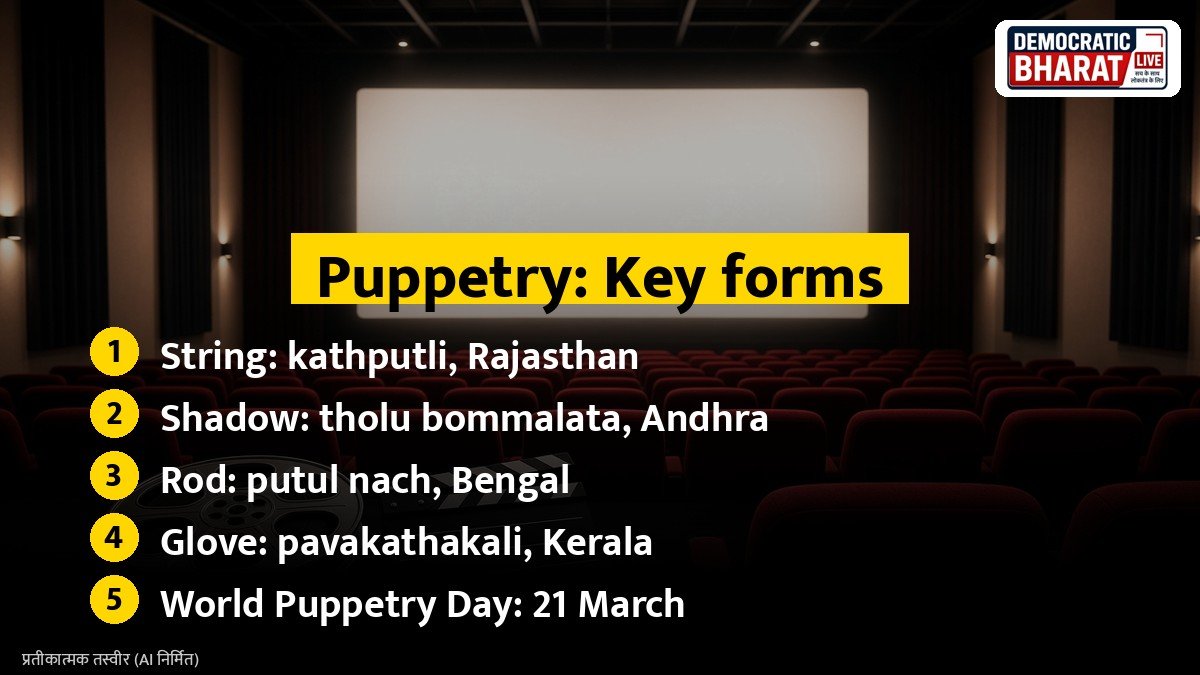
- **Kathputli, Rajasthan:** The best known Indian puppets, carved from wood and dressed in bright clothes. Stories often include the tale of Amar Singh Rathore.
- **Gombeyata, Karnataka:** Puppets with many joints, based on Yakshagana styles.
- **Bommalattam, Tamil Nadu:** Large puppets that combine strings and rods.
- **Kundhei, Odisha:** Light wooden puppets with jointed limbs.
Shadow puppets
Flat leather puppets are pressed against a white screen with a light behind them, creating coloured or dark shadows.
- **Tholu Bommalata, Andhra Pradesh:** Large, colourful leather puppets.
- **Togalu Gombeyata, Karnataka:** Smaller coloured shadow puppets.
- **Tolpavakoothu, Kerala:** Performed in temples, mainly telling the Ramayana.
- **Ravanachhaya, Odisha:** Uncoloured puppets that cast dark shadows.
Rod puppets
These puppets are held and moved with rods from below.
- **Putul Nach, West Bengal:** Large, often life size, rod puppets.
- **Yampuri, Bihar:** Wooden rod puppets.
Also Read: Folk Dances of India: State Wise List of Famous Dances and Their Traditions | IFFI Goa Guide: What Is the International Film Festival of India, Indian Panorama and How to Register
Glove puppets
The puppeteer wears the puppet like a glove and moves the head and arms with fingers.
- **Pavakathakali, Kerala:** Inspired by Kathakali, with similar costumes and stories.
- Glove puppets are also popular in Uttar Pradesh, Odisha and West Bengal.
Importance
Puppet shows were once a key way to share news, morals and stories in villages. Today, puppetry is also used in schools and awareness campaigns on health, hygiene and social issues.
Support for the art
The Sangeet Natak Akademi honours puppeteers through its awards. The Centre for Cultural Resources and Training uses puppetry in teacher training. Modern artists such as Dadi Pudumjee have taken Indian puppetry to global stages.
Challenges
Many puppeteer families have left the craft due to falling income. Festivals, workshops and digital shows are helping revive interest.
World Puppetry Day
World Puppetry Day is observed on 21 March every year.
Bottom line
From Rajasthan’s kathputli to Kerala’s shadow plays, Indian puppetry is a living art that deserves an audience.
Source / स्रोत: Sangeet Natak Akademi, Centre for Cultural Resources and Training, Ministry of Culture