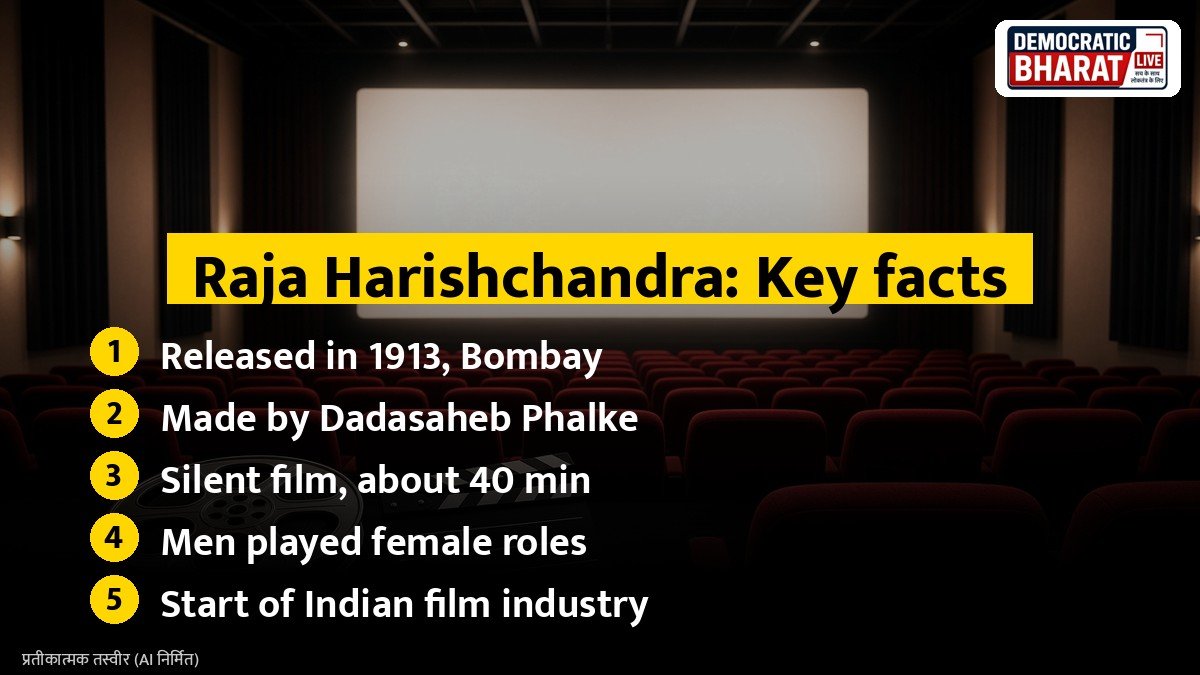
Indian cinema, now one of the largest film industries in the world, began with a silent film called Raja Harishchandra. Released in 1913, it was made by Dhundiraj Govind Phalke, better known as Dadasaheb Phalke. Here is its story.
The man behind it
Dadasaheb Phalke was born in 1870 in Trimbak, near Nashik in Maharashtra. He worked as a photographer, printer and painter. After watching a film on the life of Christ in Bombay, he was inspired to make films about Indian stories. He went to London in 1912 to learn filmmaking and buy equipment.
Making the film
Phalke wrote, directed, produced, shot and edited the film. His wife Saraswatibai helped with many technical tasks. Since it was not considered respectable for women to act in films then, men played female roles. Anna Salunke, a man, played Queen Taramati.
The story
The film tells the story of King Harishchandra from Hindu mythology, a ruler famous for his commitment to truth. To keep his word to the sage Vishwamitra, he gives up his kingdom and suffers great hardship, before the gods reward his honesty.
Also Read: Alam Ara: The Story of India’s First Talkie Film and How It Changed Indian Cinema | IFFI Goa Guide: What Is the International Film Festival of India, Indian Panorama and How to Register
Release
The film had a special screening in Bombay in April 1913 and was released to the public on 3 May 1913 at the Coronation Cinema in Bombay. It was a silent film with title cards in Marathi and English, running around 40 minutes. It was a commercial success.
Debate over first film
Some historians mention Shree Pundalik, released in 1912, as an earlier Indian film. However, Raja Harishchandra is widely accepted, including by the government, as India’s first full length feature film. The centenary of Indian cinema was celebrated in 2013.
Phalke’s later work
Phalke went on to make many more films, including Lanka Dahan in 1917 and Kaliya Mardan in 1919. He is called the Father of Indian Cinema.
Dadasaheb Phalke Award
The Government of India instituted the Dadasaheb Phalke Award in 1969, his birth centenary year. It is India’s highest film honour. Devika Rani was its first recipient.
Surviving prints
Only parts of the original film survive. Fragments are preserved by the National Film Archive of India in Pune.
Bottom line
Raja Harishchandra marked the birth of Indian cinema. A story about truth, made with great effort by Dadasaheb Phalke, began a journey that led to today’s vast film industry.
Source / स्रोत: National Film Archive of India, NFDC, Directorate of Film Festivals, Dadasaheb Phalke Award, Press Information Bureau